ISO 14001
In business is it more important ‘what you do’ or ‘how you do it’?
0“Assessing your environmental strategic planning in preparedness for ISO 14001:2015″
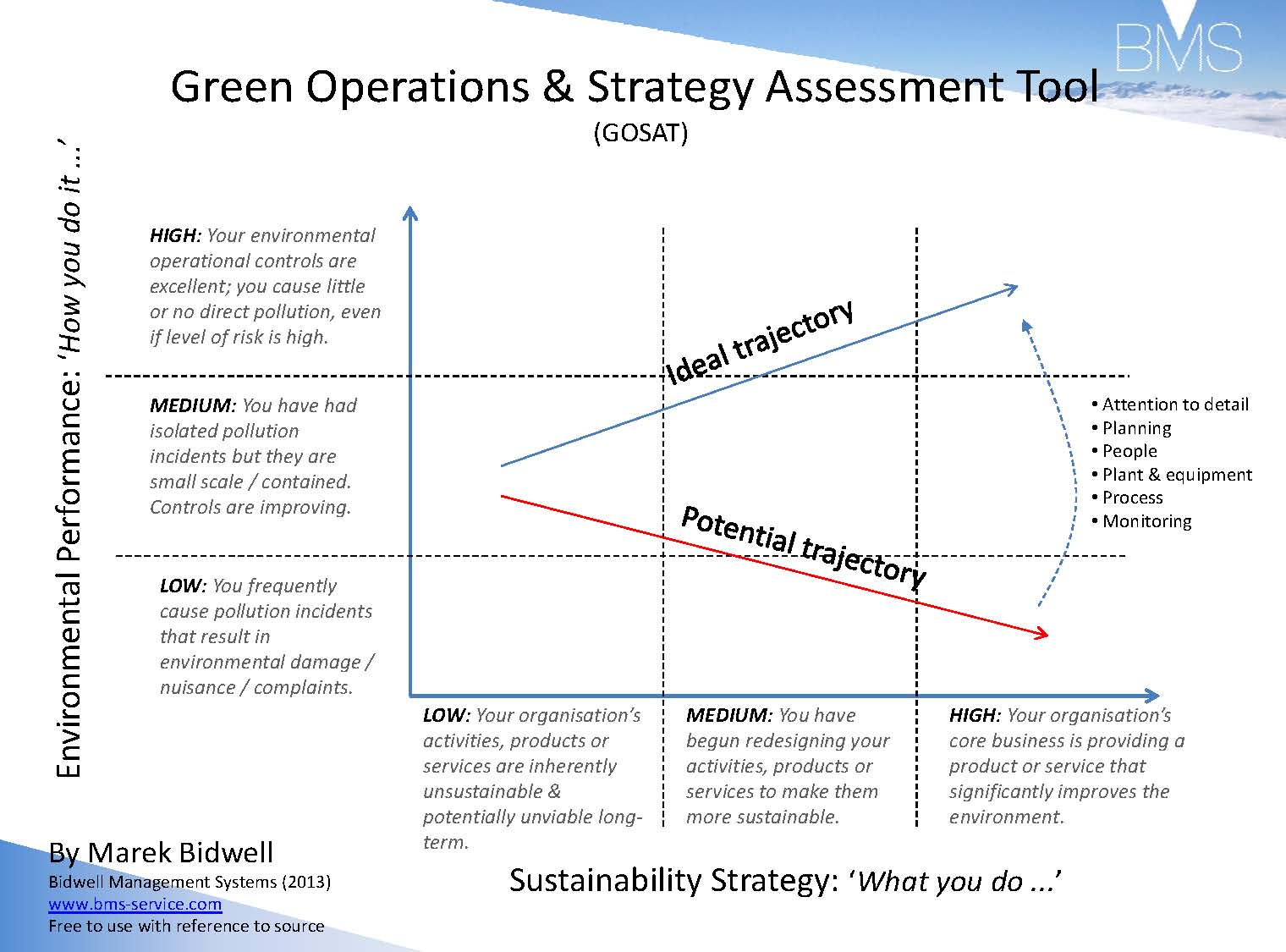
Having written previously about the changes to ISO 14001, due to be published in 2015, which are likely to include increased focus on the supply chain, ecosystems, adaptation, and products and services, in this paper I will consider one aspect in more detail, which is giving consideration to environmental performance in strategic planning: ‘what you do’ – compared with an organisation’s direct environmental impacts: ‘how you do it’. I will use the Green Operations and Strategy Assessment Tool (GOSAT) to illustrate these ideas throughout, which may be used by organisations to develop a high level strategy in this area:
In the past, quality management systems (ISO 9001 and its predecessors) got a bad name, because there was a view that you could specify rubbish and make rubbish; conformance with specified requirements was key. To a greater or lesser extent this changed with the publication of the 2000 edition, which placed much greater emphasis on monitoring processes, products and customer perception, thus driving improvement in all areas of the organisation that contribute to meeting customer requirements. This in turn encourages innovation.
ISO 14001 suffers from a similar image problem today in some quarters, as 9001 did pre-2000, but in this case the customer could be seen as the environment. As long as the organisation complies with legal and other requirements, improves in some areas, and prevents pollution (normally considered to be from its direct activities) it can continue do what it does, or making what it makes, without considering its ‘raison d’être’ and overall life-cycle impacts.
As an example let’s consider a hypothetical manufacturer of patio heaters that has ISO 14001. Their environmental policy includes a commitment to ‘greening the earth’, although perhaps ‘warming the earth’ would be a more realistic objective given the product. Such a manufacturer could have a spotless factory, use solvent-free paint, and operate a fleet of electric delivery vehicles, but it will still be making a product that many see as unnecessary and highly unsustainable. Its position on GOSAT would be in the top left-hand corner.
If the 2015 version of ISO 14001 contains a requirement for the organisation to ‘consider the result of the evaluation of significant environmental aspects as input into the design, development or change of its products and services’ it would be interesting to see if the organisation readily retained ISO 14001 with no changes, dropped that product line, redesigned it, or substituted it for something that provided an equivalent service, such as thermal underwear. Redesigning the product could include partially addressing the core issue of heating outside air, such as we saw with the electric patio heater pitch by Eddie Middleton on Dragon’s Den in 2009. They may consider ‘improving’ the product through de-materialisation or perhaps increasing its life expectancy. One way of doing this might be by switching to solvent-based paints that may be more durable, but have a greater environmental impact at the production stage. Another might be by providing a take-bake service for the product at the end of its life. The company could use GOSAT to help plan their overall environmental strategy.
Our patio heater company is not alone in this journey; there are many well-documented examples of organisations that are beginning to, or have already, re-imagined themselves along more environmentally sustainable lines. The late Ray Anderson described in his book Business Lessons from a Radical Industrialist how his flooring company, Interface, re-engineered its process to harvest used carpet tiles, thus reducing fossil fuel dependency and waste to landfill. Other organisations, such as Green and Black’s, embedded sustainability principles in their businesses from the very beginning. Green and Black’s founder, Craig Sams, always believed that organic farming was not only essential for soil quality and ecosystem integrity, but that it also resulted in tastier food. With rising resource prices, climate instability, and degradation of ecosystems there are many sound business reasons to take a long-term holistic approach to running a business.
However, does this mean that all organisations who have strong environmental credentials from a product and service point of view (what they do), have also eliminated environmental compliance and pollution risks from their business (how they do it)? My counterintuitive theory is that this is not necessarily the case, and in some areas the opposite may be true. Before reading on can you think of any examples?
I will explain by considering a different hypothetical organisation: a recycling company that specialises in diverting food waste from landfill, capturing methane, and producing renewable electricity. Its core business model is aligned with sustainability principles. It does not have ISO 14001, possibly because it is considered to be unnecessary, and such controls would be an added cost and constraint. However, while it has grasped the green opportunity, it is less competent with regards to operations. It does little in the way of process monitoring, and frequently has problems with waste deliveries backing up in its yard. Odour from one of its plants is so bad that local residents often feel trapped in their homes, which is having a direct effect on their quality of life, health, and wellbeing. The regulator has received hundreds of complaints, and despite having contacted the plant, residents are taking legal action because they are convinced the problems will continue. The recycling company’s position on GOSAT would be in the bottom right-hand corner, and they could use the model to consider improvements to their overall business strategy, thus closing the gap to the ideal greener trajectory.
I won’t give specific examples here but the Environment Agency’s Sustainable Business Report for 2011 states that the number of serious pollution incidents per 100 permits issued is actually highest for the biowaste sector at 5.5; ironically this is well above the landfill sector, which only had 0.3 serious pollution incidents per 100 permits issued.
Therefore, while some organisations have made a logical progression from pollution prevention and compliance to an all-encompassing green business model, the two do not necessarily go hand in hand. Increasingly we will have to rely on diverse and novel technologies to solve critical challenges that we face, such as resource scarcity, adverse weather, food shortages, increasing migration of pests, rising CO2 emissions, and degradation of ecosystems. These technologies will not necessarily be risk free, and in some case may have greater safety and environmental operational risks than their predecessors. I have always said that there is no silver bullet when it comes to environmental management.
In summary I believe that ‘what you do’ and ‘how you do it’ must go hand in hand in order to solve global problems, prevent local pollution, and preserve the overall reputation of an organisation or brand.
The increased emphasis on environmental sustainability in the 2015 version of ISO 14001 will encourage many organisations to embed it into their business model, not only raising the profile of environmental management with the organisation but engaging leaders with opportunities presented by the green economy. Organisations exploiting new technologies however, large and small, would be advised to consider pollution prevention and neighbourhood impacts in equal importance to the bigger picture.
Please use the Green Operations and Strategy Assessment Tool (GOSAT) presented in this article to assess your organisation referencing the source. For more detailed analysis and guidance Bidwell Management Systems provides an ISO 14001:2015 Preparedness Service; contact Marek Bidwell (marek@bms-service.com) for more details.
By Marek Bidwell (2013)
Audit Checklists: A help or hindrance?
0
When carrying out management system internal audits for health & safety, environmental, and quality some organisations use standard audit checklists, but do these checklists add value to the audit process or dumb it down?
Developing a personal audit checklist is a vital part of planning for each audit that I focus on during audit training courses. The process of reviewing the audit criteria such as relevant legislation, company procedures, and standards (eg: ISO 14001, ISO 9001, OHSAS 18001) enables the auditor to make sense of the requirements, structure them into a series of logical questions, avoid repetition during the audit, and arrive well prepared. I stress that these checklists should not just be a list of questions to ask, but also physical evidence to look for, and documents to review, thus incorporating the full range of audit evidence. In its simplest form an audit checklist could be the relevant company process or procedure annotated or highlighted by the auditor, to use as an aid memoir during the audit. (more…)
Audit Skills: Are you a Back to Front, or Front to Back Auditor?
0Verification of audit information is a key skill for carrying out an internal audit but the extent of verification, and techniques used, are often highly variable, and may have a significant impact on the validity of your audit findings.
Imagine that you are auditing a transport procedure for a company with a fleet of vehicles. The procedure requires that each vehicle is logged on a database including details such as service intervals, insurance details, and input of monthly mileage data. How would you sample this information and check that the overall process is working?
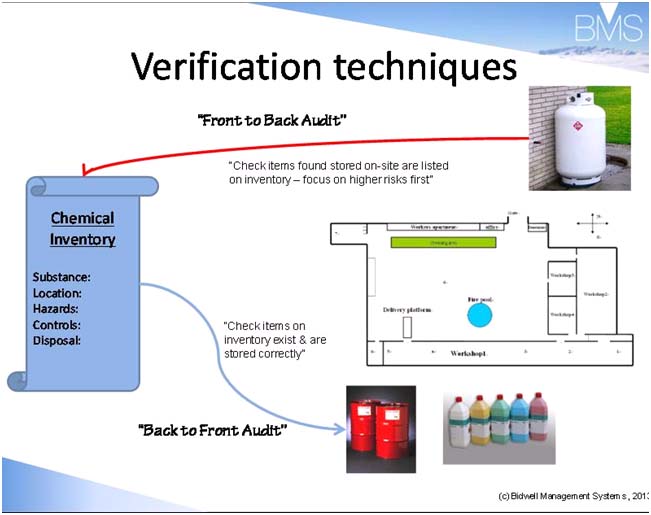
Observing hundreds of auditors in training I have noticed that many are comfortable discussing the process with the responsible person, taking a sample of information from a database, and then checking this information in a filing system. In this case they may also take sample mileage details from the database and check these against vehicle mileometers in the car park. I call this “back to front auditing”, or checking input data against reality. The auditee is normally relatively confident at this stage because we are checking what they know exists and have records for. In this example it is unlikely that a known vehicle will have missed its MOT or service, and any gaps in mileage data will show up clearly on the database. (more…)
Top five questions asked by new Internal Auditors
0This week I have been running a health & safety internal auditor course and it struck me that whatever the standard or organisation the primary concerns of newly trained internal auditors are consistent. During the course I made a note of some of these common questions, and have added answers below.
Q1a: How long will the internal audits take me?
This is probably the number one question asked by newly trained internal auditors. (more…)
Checking the health of your internal audit programme
0Many internal audit programmes operate at a sub-optimal level, without this being clear to the Environmental Management Representative and business management, until an external certification raises non-conformances against the process. Internal audit is a vital part of ISO 14001, providing the “self healing” in the system, and constitutes a core part of the Plan-Do-Check-Act cycle for continual improvement. The Internal Audit Service offer an audit health check service for businesses, where one of our consultants will intensively review your existing audit schedule, reports and corrective action programme, and make recommendations for improvement and enhancement. (more…)
Internal Audit Service support reduces external audit requirement
0Internal audit is a vital part of a management system, delivering internal check and action planning which ensures the ongoing health of the system. A good internal audit programme can demonstrate to external assessors that a system is effective, active and well managed. This was illustrated recently when BMS provided support to an organisation in the run-up to external certification of their existing ISO 14001 EMS, including completing a full internal audit of the system. As a result of the support provided by BMS, the client’s external certification visit was reduced from two man days to one man day, with the external audit stating:
Notes on Sustainability Communications Webinar by IEMA / Sustain-affinity
0On 17th May Sustain-affinity and IEMA hosted a webinar called “30 ways to reduce your impacts and impacts and initiate engagement”
These are my personal notes for sharing; my comments are in italics, – Marek Bidwell (more…)
What you need to know to future proof your EMS
0ISO 14001 is changing. Work is underway to substantially revise the structure, content and requirements of the environmental standard, with a view to launching the revised version in 2017. But Environmental Managers need to be thinking about these changes now. Bidwell Management Systems have been actively engaged with our clients and IEMA on the proposed revision to ISO 14001. We attended a key workshop session organised by IEMA in January, and provided input into the general debate, and since then have been liaising with IEMA providing recommendations based on BMS’ practitioner involvement in establishing and implementing ISO 14001 based Environmental Management Systems. (more…)